Posted on

Preston Property Update: June 2024

Preston Property Update: June 2024

Preston Property Update: June 2024

What’s Happening with Property Prices?

Ah, the UK property market—always a rollercoaster of emotions, figures, and occasionally, humour. In the past 12 months, we’ve seen a fascinating saga unfold in both the national and local (Preston) property markets. Let’s dive into the current trends, sentiments, and some juicy stats to get a better understanding.

National Scene: UK House Prices

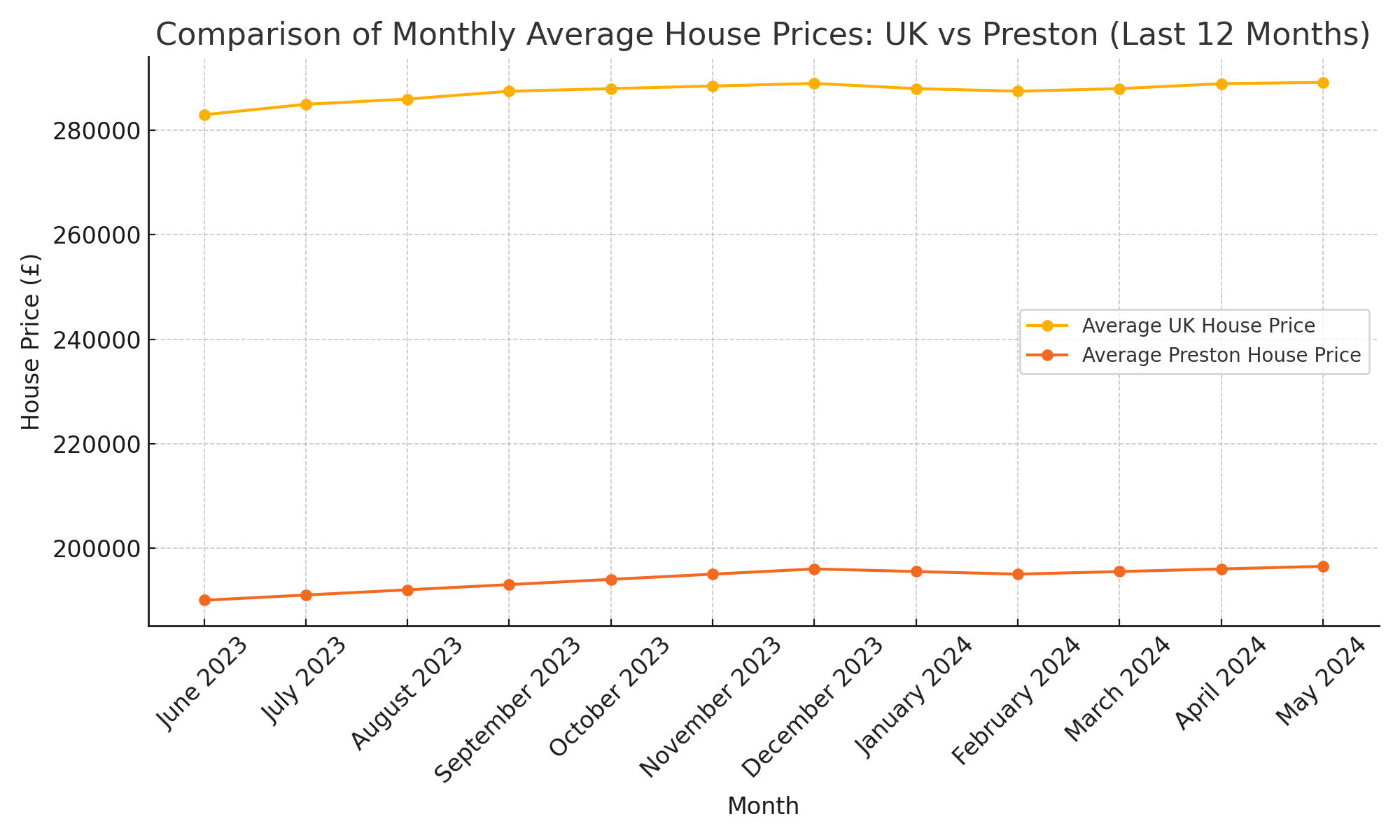
According to the Halifax House Price Index, the average UK house price in April 2024 was £288,949, showing a modest annual growth of 1.1%. Amanda Bryden, Head of Mortgages at Halifax, notes, “UK house prices held steady in April, rising on a monthly basis by just +0.1% (less than £200 in cash terms).” While this may sound like the market is catching its breath, it’s important to note that there are broader dynamics at play.

The national market has experienced what some might call a plateau. After a period of rapid growth, things have stabilised, partly due to the increase in interest rates. The average property price has only seen a slight uptick compared to £287,244 at the beginning of the year. Mortgage applications are up, and mortgage approvals have reached an 18-month high, indicating that buyer confidence is making a comeback.

Interestingly, first-time buyers are shifting their preferences towards smaller properties, likely due to higher borrowing costs. Flats have seen the most significant price increases, suggesting a narrowing gap between smaller and larger properties.

Local Spotlight: Preston House Prices

Now, zooming in on our local hero, Preston, the story takes a different twist. The average house price in Preston stands at £196,500, marking a steady rise from £190,000 over the past year. While Preston’s prices are lower than the national average, the growth rate is quite notable, signalling a robust local market.

The local sentiment mirrors the national trend of cautious optimism. Buyers in Preston are gradually regaining confidence, reflected in the stable and consistent rise in property values. The market here is characterised by a balance between supply and demand, without the dramatic fluctuations seen in some other regions.
Market Sentiments and Trends

Across the UK, market sentiment is cautiously optimistic. Despite higher borrowing costs, buyers are adapting, and the market shows signs of resilience. As Amanda Bryden puts it, “Activity and demand are improving, evidenced by greater numbers of mortgage applications so far this year.”

In Preston, the sentiment is similarly positive. The local market benefits from a mix of affordable housing and growing demand, particularly from first-time buyers and young families. This steady demand is helping to sustain price growth without overheating the market.

Expert Insights

From the Halifax House Price Index, Amanda Bryden provides a comprehensive overview: “While borrowing costs remain more expensive than a few years ago, homebuyers are gaining confidence from a period of relative stability.” This reflects a broader sentiment of a market that is adjusting and finding its footing in a new economic landscape.

Locally, insights from the Office for National Statistics (ONS) highlight Preston’s strong performance. The average house price here is growing steadily, a sign of a healthy and balanced market.

12-Month Outlook and Forecast

Looking ahead, the property market’s trajectory is expected to be steady, if not spectacular. Nationally, house prices are anticipated to rise modestly. The resilience displayed over recent months suggests that we can expect continued, albeit moderate, growth. If the Bank of England implements expected rate cuts later this year, fixed mortgage rates might fall, further boosting buyer confidence.

For Preston, the forecast is similarly positive. The local market’s stability and affordability make it an attractive option for buyers. As demand continues to grow, we can expect house prices to follow a steady upward path. However, affordability remains a key issue. Both new buyers and those remortgaging need to navigate higher mortgage rates carefully.

In conclusion, while the national market finds its footing in an era of higher interest rates, Preston shines as a beacon of stability and growth. With cautious optimism, buyers and investors can look forward to a property market that, while not without its challenges, offers opportunities for growth and stability. As always, stay tuned to your local expert for the latest updates and insights. Happy house hunting, and may your property dreams be ever in your favour!


Posted on

Prepare your important rooms to sell

The two most important rooms in a property for buyers are the kitchen and the bathroom. That is because they can be the two that are the most expensive to renovate. A cost-effective option is home staging. Staging these rooms correctly can make a real difference to your selling price. 


Less is more

Clutter is always a turn-off for buyers. Not only is it distracting but it can also prevent them from being able to imagine them living in your property. No-one wants to imagine themselves living in a cluttered space full of someone else’s personal items. 


Remove all clutter from the sides and cupboards, including photographs and fridge magnets, and focus on creating a picture perfect kitchen that wouldn’t look out of place on Instagram. A vase of freshly cut flowers or a strategically placed cake stand can be just what your kitchen needs to turn it into someone’s idea of a dream kitchen. 


Upgrade

New kitchens and bathroom suites are expensive and most of us can’t afford to replace them when we are trying to sell our properties. However, there are several things that you can do to turn your kitchen from drab to fab without having to spend a fortune. 


If your cupboard doors are looking a bit worn out, consider giving them a fresh coat of paint and buying them some new, modern handles to give them a completely new look. 


Colour

A neutral colour palette is always the best choice when you are trying to sell your property, as it allows potential buyers to see your property as a blank slate to which they can add their own personality. However, it is possible to have too much of a good thing and with a neutral palette, too much can be a bit bland, so add a few pops of colour with wall art or a few colourful cooking pots.


Light

The way in which a space is lit can make a real difference to how it feels. Consider having a variety of different light fixtures in both rooms. 


Pendant lights are an excellent way of lighting a kitchen table, and under cabinet lights can provide useful illumination when preparing a meal on the worktop. In your bathroom, invest in a mirror light as well as an overhead light for a glamorous feel.


Scent

Make sure that you clean both rooms thoroughly in order to ensure there are no bad smells. Once this is done, consider adding scents that are attractive to people, like vanilla or ‘fresh linen’. 


Making your property somewhere that your buyers would like to spend time makes them much more likely to want to put in an offer, so taking the time to ensure that the most used rooms in the property are covetable is well worth the effort. 


If you would like more advice on how to get your property in Walton-le-Dale ready for viewings please give us a call on 01772 252136 or send an email to info@stonehousehomes.co.uk.

Posted on

How to embrace Summer vibes in your interior decor

As the days become longer and the sun shines brighter, it’s time to infuse your living spaces with the cool essence of summer. The most effective way to create a dynamic and energetic atmosphere that complements the easygoing spirit of the season is to embrace summer influences in your decor. Here are four, simple but impactful ways to easily transform your home into a summer haven.


Embrace Light

The foundation of summer decor is to create a room that is light and airy. Open the curtains to let in natural light, which will instantly brighten the space. To maintain privacy while still allowing a mild breeze to pass through, choose sheer or lightweight curtains. Select furnishings and fabrics in light colours to reflect the sunlight, which will help to create the impression of space. Mirrors should be strategically incorporated in order to boost the amount of natural light by reflecting it around the space and giving it a sense of depth.


Embrace Nature

Incorporating natural components into your interior design can help you feel more connected to the environment. Bring potted plants or fresh flowers into your home in order to add colour and natural beauty. To create a seaside atmosphere, arrange seashells, coral, or driftwood as centrepieces or on shelves. Include natural materials in your furniture or accessories, such as rattan, jute, or wicker, to create an organic and welcoming feel. To add a hint of botanical charm, think about purchasing artwork or posters with a botanical theme.


Inject Colour and Patterns

If your interior colour scheme is looking a little tired, then it’s time to revitalise it because summer brings to mind a kaleidoscope of brilliant hues. Add splashes of vibrant, upbeat colours like lemon yellow, coral, turquoise, or tropical greens. Try out dramatic patterns in your curtains, rugs, or throw cushions by combining floral, nautical, or geometric motifs. Don’t be afraid to mix and match patterns to give the space a whimsical touch and create a vibrant, upbeat mood.


Relax

Summertime is all about relaxing and taking it easy. Create areas where you can unwind and enjoy the summer atmosphere. Set up cosy seating areas with luxurious throws and cushions in tropical designs on your patio, balcony, or terrace. Create comfortable reading nooks with extra-large chairs or hammocks that are furnished with soft, lightweight blankets. For optimal relaxation, invest in scented candles or diffusers that emit energising citrus or floral scents.

If you are considering putting your property on the market in Walton-le-Dale and would like to know more about how to style it for summer viewings then please give us a call on 01772 252136 or send us an email to info@stonehousehomes.co.uk.

Posted on

Tenancy facts you should know

Are you looking to rent a property for the first time and would like to know more about what you can expect? In this blog, we  will look at the most important things that you need to know as a tenant.


  • Fire and General Safety

Your landlord has legal obligations when it comes to your safety. They must ensure that a property has appropriate fire escape routes. There should also be at least one smoke alarm per floor. If a fireplace is in use, then the room should also have a carbon monoxide detector.

If a property is classified as a House of Multiple Occupation (HMO), your landlord is required to install fire alarms, extinguishers, and fire blankets on every floor.

The landlord is responsible for maintaining the fire alarms, but you also have a responsibility to report any faulty alarms to them in between inspections.


  • Landlord Visits

Landlords and letting agents must give at least 24 hours notice before entering the property for viewings or to gain access to carry out repairs. If you cannot be there at the time they request, you can opt to have a trusted person be there on your behalf.


  • Appliance Checks

It is a legal requirement for gas appliances to be checked annually by a Gas Safe registered engineer. A record of these checks should be kept at the property. The landlord must show you the most recent gas safety certificate before you sign your tenancy agreement.

Electrical appliances, such as kettles or toasters, must pass a Portable Appliance Testing (PAT) test once every five years.


  • Infestations or Pests

Promptly notify your landlord if you find an infestation of bedbugs or encounter mice, bats, or rats inside the property. You will also need to contact the local health authority if you find rats, as they pose health risks.

If you bought furniture and then found it had bedbugs, then it is your responsibility to deal with them, but you will still need to inform your landlord. If the bedbugs were already in the property or were in furniture your landlord brought into the property, then it is the landlord’s responsibility to dispose of it and deal with them.


  • Guests and Sleepovers

Renting out rooms or accepting money from guests for their stay (sub-letting) is prohibited in most tenancy agreements and can lead to eviction.

If you are living in an HMO, then it is crucial to discuss and come to an understanding with your housemates about guests staying over because most tenancy agreements do not have clear rules about this. Be considerate if your visitors will be sleeping in common areas, and keep in mind that you are liable for any damage your visitors may cause.


  • Decorating

Obtain your landlord’s or letting agent’s written consent before making any big changes, such as painting the walls. When decorating, refrain from damaging the walls in any way, such as by using nails or blu-tack. Generally speaking, the property should be in the same state as when you moved in when you leave.


  • Maintenance

Contact your landlord immediately if there are any problems with the property that could lead to accidents. Most landlords will take care of the required repairs right away. If your landlord refuses to undertake any necessary repairs, seek advice from the Citizens Advice Bureau.


  • Evictions

A landlord may evict a tenant for a number of legitimate reasons, including repeated late rent payments, violation of the tenancy agreement, annoyance to neighbours, or participation in unlawful activities.

If you are threatened with eviction, you should seek advice straightaway. Landlords are prohibited from evicting tenants by threatening them, shutting off their utilities, or withholding repairs or keys.


  • Notice to Leave

Your landlord is required to give you at least two months’ notice if they want you to leave. You have the option to terminate your tenancy agreement early in some situations, such as when your landlord fails to uphold their obligations. If not, you will still be responsible for paying the rent until the agreement expires.


  • Housing Deposit

Your housing deposit must be legally held by your landlord in a government-approved deposit protection scheme. They must let you know which scheme your money has been placed in. In the event of a dispute, this safeguards both parties. You might be entitled to reimbursement or compensation if your landlord doesn’t deposit your money within 30 days.


Make sure that you give us a call on 01772 252136 or email info@stonehousehomes.co.uk if you are looking to rent a property in Walton-le-Dale so that we  can add you to our  earlybird list. This means that you will be one of the first to see our  latest available properties.

Posted on

Should I lower my asking price?

It can be challenging to sell a house, especially if it sits on the market for a long time with no interested buyers. As a last resort, a lot of homeowners think about lowering their asking price, but is this always the wisest course of action?

It’s important to speak with your estate agent to gain the necessary information you need prior to making any decisions. Ask your estate agent why they think the reduction in price is appropriate, and consider whether the market or demand for properties similar to yours has changed dramatically.

Even if lowering the price could attract more attention, it might also have unforeseen repercussions, especially for high-end properties. In this blog, I will go over the pros and cons of lowering your asking price to provide you with the information you need to make a wise choice and improve your chances of making a sale.


The Pros and Cons of Price Reduction

For some properties, reducing the asking price may attract potential buyers who couldn’t previously afford it. Price reductions may also be necessary due to urgent moves or impending repossessions.

It’s important to keep in mind, though, that lowering the asking price might not always be the best course of action, particularly for expensive homes.

A price drop can cause suspicion among buyers, who may wonder, “What’s wrong with it?” A buyer may not want to risk buying a house that seems to be falling in value. A property with lots of historical price drops is inherently unattractive to a buyer, as each drop can signify a red flag, so if you do decide to drop the price, make sure your price drop is big and impactful and only do it once.

Let’s look at some different tactics that can help you achieve your asking price rather than automatically lowering it.


Effective Marketing and Presentation

There are other factors that can affect the sale of your property besides price. To maximise your marketing efforts, work closely with your estate agent. Aerial views, twilight photos, and up-to-date lifestyle photography could help increase the appeal of your property. Putting your property on display in the best possible way can greatly boost its desirability and aid prospective buyers in visualising themselves living there. To increase your house’s “saleability,” consider investing in professional home styling.


Negotiation and Timing

It’s crucial to find a balance between getting a good price and moving the sale along when negotiating with prospective purchasers. While some haggling is normal, it’s best to avoid giving up too much. Properties often sell for between 95% and 97% of their asking price, with the reduction being achieved through negotiations.

Timing is equally important. You may need to modify your price expectations if there are any deadlines that must be met or if there are any personal reasons why a transaction must happen quickly.

It’s important to think carefully before lowering your property’s asking price. Keep in mind that setting an asking price is only the first step in the selling process. A successful sale can be aided by having a well-thought-out strategy in place, exploring different marketing techniques, and staging your home to its greatest advantage. Whether you decide to change the asking price or pursue alternative options, it’s crucial to be confident in your choices and seek advice from experienced professionals.


If you would like more advice on whether reducing the asking price of your property in Walton-le-Dale is the right decision for you please give us a call on 01772 252136 or send an email to info@stonehousehomes.co.uk.

Posted on

May 2023 Monthly Market Report for Walton-le-Dale

May passed in a glorious haze of spring sunshine, pomp, and ceremony. The three bank holiday weekends gave homebuyers plenty of opportunities to view properties, and this certainly had an effect on the number of sales agreed!


The lovely weather looks set to continue into June, enticing more buyers out and giving sellers the opportunity to show off their properties in the always-flattering sunshine. This is always a busy time of year for the property market, so if you are considering putting your property on the market, you couldn’t choose a better time than now.


Let’s have a brief look at what’s been happening over the last month in the local property market around Walton-Le-Dale.


Properties in Walton-Le-Dale had an overall average price of £192,983 over the last year.

There are currently 1318 properties available on the market in our area. This is an increase of 6% since last month, when there were 1245. In March, 1270 were available; in February, there were 1187; and in January, there were 1155.

In May, 315 properties came onto the market. In April, 277 came onto the market; in March, there were 349; in February, there were 280; and in January, there were 247.

There were 262 sales agreed in May. This was an increase of 27% compared to the month before when 206 sales were agreed. In March, there were 244; in February, there were 213; in January, 192 sales were agreed; and in December, there were 130. More sales were agreed during May than in any of the previous six months. These figures clearly demonstrate that despite the national media’s attempts to create the impression that the property market is all doom and gloom, the local property market is actually busier than ever.  

The majority of sales in Walton-Le-Dale during the last year were semi-detached properties, selling for an average price of £187,680. Terraced properties sold for an average of £142,941, with detached properties fetching £305,935.

Overall, sold prices in Walton-Le-Dale over the last year were 2% up on the previous year and 7% up on the 2020 peak of £180,328.

In January, we saw 134 price reductions across the Walton-Le-Dale property market. In February, there were 131; in March, there were 164; in April, there were 158; and in May, there were 149. The increase during the last few months was likely a result of sellers wanting to capitalise on the Spring Rush by making sure that their property caught the eye of motivated homebuyers. As the market settles back down again, the number of price reductions is reducing too. 

In May, there were 597 slow movers in the Walton-le-Dale area. This is a property that has been on the market for 12 weeks or more. In April, there were 546; in March, there were 612; in February, there were 602; and in January, there were 639. 

Slow movers can often be due to the 3 Ps: presentation, promotion, or price. We are proud to be in the top 10 agents in the area with the smallest number of slow movers. Choosing the right agent for your property can make a very real difference in achieving your moving plans.

In January, each property in the Walton-le-Dale area had an average of 75 daily views on Rightmove. The average daily views on Rightmove per property increased to 79.8 in February. In March, there were 66.3; in April there were 62.6 and in May there were 55.6. This is not an indication that the local property market is getting quieter. What it means is that there are now more serious buyers as opposed to winter window shoppers. 

If you’re looking for further information about the Walton-Le-Dale property market, or if you’re thinking of selling or buying in the area, please don’t hesitate to get in touch. You can call 01772 252136 or email info@stonehousehomes.co.uk.

Posted on

How to maintain your roof

All property owners are aware of how important their roof is, but very few actually know how to maintain it. 

If you are a self-managing landlord, it’s even more important that you check your roof regularly. Under Section 11 of Landlord and Tenant Act, you’re responsible for all external fixtures. 

Catching problems early can prevent them from turning into bigger, more expensive ones. Be sure to ask your tenants to help by reporting any issues they might notice too.

 Here is our  quick guide on how to keep your roof in good condition.


How often should you check it?

Regular inspections are essential to spot any issues early. We  recommend checking your roof at least twice a year. The beginning of Spring and Autumn are the optimal times.


What are you looking for?

The most obvious thing to look for is whether you can see the sky through your roof! However, there are other, less obvious things you also need to check for, such as:

  • Damaged or misaligned guttering
  • Missing or damaged slates or tiles
  • Any moss or algae growth
  • Watermarks on the wood or insulation
  • Signs of deterioration or mould
  • Indications of bowing or damage
  • The flashing around your chimney or dormer windows not sitting flush.


Clean your gutters

Gutters channel water away from your property. If they get blocked, they can cause a leak quickly, so make sure that you clean them out regularly, increasing the frequency during Autumn.


Clear moss

Moss soaks up water like a sponge. Water in constant contact with your roof can cause rafters to rot, and in cold weather, when it freezes, it can lead to cracked tiles.

This is why it’s important to remove moss wherever possible.


Trees

Falling branches can damage roof tiles, and falling leaves can block gutters. If you have any trees near your property, make sure that you keep them neatly trimmed to reduce the chance of them damaging your roof.


Remove debris

Clumps of rotting leaves or a buildup of twigs can hamper the ability of water to run off of your roof, leading to the same issues that moss causes.


If you do find a problem, make sure that you deal with it quickly by employing a professional roofer. Attempting to fix problems yourself can be dangerous, and you will save money in the long run if you plan to sell or let your property, as you will be certain that the roof is well-maintained.


If you need recommendations for local tradespeople to help with things like your roof or nearby trees, just get in touch. We  know all the best people in our area for these sorts of jobs.


If you are thinking of letting your property in Walton-le-Dale and would like more advice on how to get it ready to let then please give us a call on 01772 252136 or send an email to info@stonehousehomes.co.uk and we  will be happy to help you.

Posted on

How to work out the rental yield of your property

Being able to calculate the rental yield of a property is vital for investors and landlords, as it helps them to identify how profitable a rental property is. Rental yield, put simply, is the return on investment a landlord might anticipate from a rental property.


The rental income, property valuation, and costs related to owning and maintaining the property are some of the key elements that go into calculating rental yield.


This is how to calculate a property’s rental yield:


Work out the yearly rental income.

Calculating the property’s yearly rental income is the first step. Multiply the monthly rent by 12 to achieve this.

For instance, if the monthly rent is £700, multiplying that by 12 gives an annual rental income of £8,400.


Get a valuation

Asking an estate agent to do a valuation of your property is the easiest way to find out its current market value. It is possible to estimate by looking at the prices that nearby properties of a similar size have sold for but a knowledgeable local estate agent will be able to give you a more accurate valuation that will take into account your property’s condition and any unusual features.


Work out the gross rental yield.

The annual rental income to property value ratio, stated as a percentage, is known as the gross rental yield. Divide the annual rental income by the property value, then multiply the result by 100 to get the gross rental yield.

For instance, the following formula would be used to determine the gross rental yield using the data from the preceding steps:

£8,400 is the annual rental income.

Property worth is $250,000.

Gross rental yield is equal to (8,400/250,000) x 100 = 3.34

This indicates that 3.34% of the property’s value is represented by the annual rental income.

Make sure to include expenses when calculating net rental yield.

The costs related to owning and operating the property are not included in the gross rental yield. Subtract these costs from the annual rental income and then divide by the property value to arrive at the net rental yield.

Property taxes, insurance, maintenance expenditures, property management charges, and any other costs related to owning and maintaining the property are all considered expenses.

Let’s say, for instance, that the property costs £4,000 in annual expenses.


To calculate the net rental yield you need to do the following:

Annual expenditures – Annual Rental Income = Net Rental Income, (£8,400 – £4,000 = £4,400)

Net rental yield is equal to (4,400/250,000) times 100 = 1.74%

Making educated decisions about the prospective profitability of a rental property is much easier when you know how to calculate the rental yield. Landlords can determine both gross and net rental yields to evaluate the return on their investment by taking into account the rental income, property value, and expenses.


If you are considering purchasing a new buy-to-let, get in touch to find out about why we  could help you to manage your property.


Or if you are a current landlord, could it be time for a profitability review of your property portfolio to ensure you are maximising your investments?


Please give us a call on 01772 252136 or send an email to info@stonehousehomes.co.uk.

Posted on

How to Prepare for Tenant Turnover

Being ready for tenant turnover is one of the most important components of maintaining a rental property as a landlord.


Landlords must react quickly to prepare the property for the next tenant once a tenant vacates. You can reduce the amount of time your rental property is vacant by following a few simple steps to make the transition from one tenant to the next quick and easy.


Here are our  top tips.


Perform a check-out inspection


To get ready for a tenant turnover, start by doing a check-out inspection. Before the next tenant moves in, this inspection will provide you with a clear understanding of any repairs or cleaning that are required.


It’s crucial to perform a complete inspection of the property, checking the walls, flooring, appliances, and fixtures. Keep a log of everything, note any problems or damages, and if required, take photos.


That log is your evidence if you need to deduct any money from the leaving tenant’s deposit.


Clean and repair

If required, the property will need to be cleaned and repaired after the check-out inspection is completed. Most cleaning companies can undertake an ‘end of tenancy clean.’


Don’t forget to replace any burned-out light bulbs and check the smoke alarms. If you found any damage during the check-out inspection, such as holes in the walls, cracked tiles, or damaged appliances, then be sure to fix them before your new tenants move in.


Update your documentation

Make sure to update all essential paperwork prior to the next tenant moving in. This entails revising the tenancy agreement, updating the inventory document, preparing the move-in inspection report, and ensuring that you have all of the documentation that you are legally required to provide to your tenants.


A valid Electrical Installation Condition Report must be obtained before the tenancy begins, for all rental properties since 1 April 2021. This is so that any corrective work that has been determined to be necessary in the report can be finished before the tenant moves in. Unless otherwise stated in the report, an EICR is valid for five years.


It is a legal requirement for landlords to arrange a gas safety check every 12 months with a Gas Safe engineer. They are legally required to give a copy to their tenants before their tenancy starts. The landlord has 28 days from the date the report is issued to rectify any faults that are highlighted in it.


An EPC (Energy Performance Certificate) is required for your property if you are starting a new tenancy with new tenants. Every property listing should include the EPC rating, and landlords are required by law to give tenants a copy of the EPC upon request. They are valid for ten years.


Market your property

Once all relevant paperwork has been updated, the property has been cleaned, and any necessary repairs have been made, it is time to start marketing your property.


To attract potential tenants, use social media, online property portals, and consider employing the assistance of a letting agent who may already have potential tenants waiting.


Be sure to draw attention to your property’s strongest features, including its amenities, location, and any recent renovations or improvements.


Check references

Make sure you properly review all applications you get from prospective tenants. Check their credit history, confirm their employment, check references, and get in touch with former landlords. This will help you choose a trustworthy tenant who will look after your property and pay rent on time.


If your tenants are moving out and you would like to find out how we  can help you find a reliable new tenant in Walton-le-Dale then please give us a call on 01772 252136 or send us an email to info@stonehousehomes.co.uk

Posted on

How to Sell Your Home Quickly

The process of selling a property can be time-consuming and frustrating. It frequently entails a number of stages, ranging from decluttering, organising, and staging to dealing with viewings and negotiating with prospective buyers. 


There are, however, ways to expedite the selling process and sell your house quickly without compromising on the price.


For those wishing to sell their property quickly, here is some advice.


Eliminate clutter and depersonalise

Decluttering and depersonalising your property is one of the first steps towards getting it ready for sale. If the property is cluttered and overrun with personal items, it may be difficult for prospective buyers to envision themselves living there. 


Start by getting rid of anything that isn’t necessary or doesn’t improve the appearance of the property. Potential buyers find clean and spacious properties more desirable.


Staging

Another strategy to speed up the selling process is to stage your property. This entails furnishing and decorating your property in a way that encourages potential buyers to feel welcome and creates a feeling of space and light. Potential buyers will feel more at ease and confident about making an offer after viewing a well-staged house.


Work with an experienced estate agent.

Working with an experienced estate agent is one of the most important factors in helping you sell your house quickly. 


A professional, experienced agent will be able to help you determine the appropriate price for your property, market it successfully, and negotiate with prospective buyers since they will have thorough knowledge of the local housing market. They can also offer helpful suggestions on decluttering and staging, as well as guide you through the selling process.


Price your property competitively.

In order to ensure that your property sells quickly, you must set the correct price. A property that is overpriced may take a while to sell and put off prospective buyers. On the other hand, if it is priced too low, you can find yourself passing up money. 


An experienced estate agent can provide advice and help you set the right price based on the recent sale prices of similar properties in your neighbourhood and the current state of the housing market.


Effectively marketing your property

Marketing your property effectively is another important aspect of selling it quickly. This entails producing high-quality images and videos that highlight your property’s best qualities, then ensuring that it is listed on all of the well-known online property portals, in local property magazines, and on all of the social media platforms. 


An expert estate agent will help you develop a marketing strategy that will attract prospective buyers, as they have a thorough understanding of the most efficient and effective marketing techniques.


Getting ready for viewings

You must prepare for open houses and viewings when your property is on the market. Ensure that your property is kept clean and uncluttered, make any necessary repairs, and make sure that it is always ready for prospective buyers to visit. 

A knowledgeable estate agent can provide helpful guidance on how to get ready for viewings and open houses, in addition to providing support throughout every step of the process.


In conclusion, it is feasible to sell your house quickly; however, it is not always simple. You can hasten the selling process and achieve a successful sale by decluttering and staging your property, working with an experienced estate agent, setting a competitive asking price, marketing your home effectively, and getting ready for viewings and open houses. Though it’s crucial to take your time and do things properly, if you have the appropriate plans in place, you can sell your house swiftly and move on to the next phase of your life.


If you are considering selling your property and would like to know why we  believe that we  are the best choice to help you please give us a call on 01772 252136 or send us an email to info@stonehousehomes.co.uk.